You can drive the Alaska Highway for days and never see the turnoff. Twelve miles past Tok, at a spot called Tetlin Junction, a two-lane road heads north toward the Canadian border. Most travelers keep going.
The ones who turn find a town called Chicken.
It sits at about Mile 66 of the Taylor Highway, a 160-mile road built between 1947 and 1951 that the state only keeps open from April to mid-October (Alaska DOT&PF). The 2020 Census counted 12 people living here year-round (Wikipedia, citing the U.S. Census).
Everybody asks about the name first. The town gives two answers, and only one of them is likely to be true.
The Story Everyone Tells
Local legend: The first miners lived through a hard winter by eating ptarmigan, a grouse-like bird that’s now Alaska’s state bird. They were grateful enough to name the camp after it. Then they ran into a problem: nobody could spell “ptarmigan.” So they picked something easier.
A 1942 Anchorage Daily Times article put it this way: when it came down to it, nobody knew how to spell the word, “so they said: ‘Oh, we might as well call it Chicken and be done with it’” (Anchorage Daily News).
It’s a great story. It’s on souvenir mugs and road-trip blogs, and the Chicken shorts open with it. But it showed up in print decades after the town was named, and it became popular in the 1940s (Anchorage Daily News).
The Story in the Record
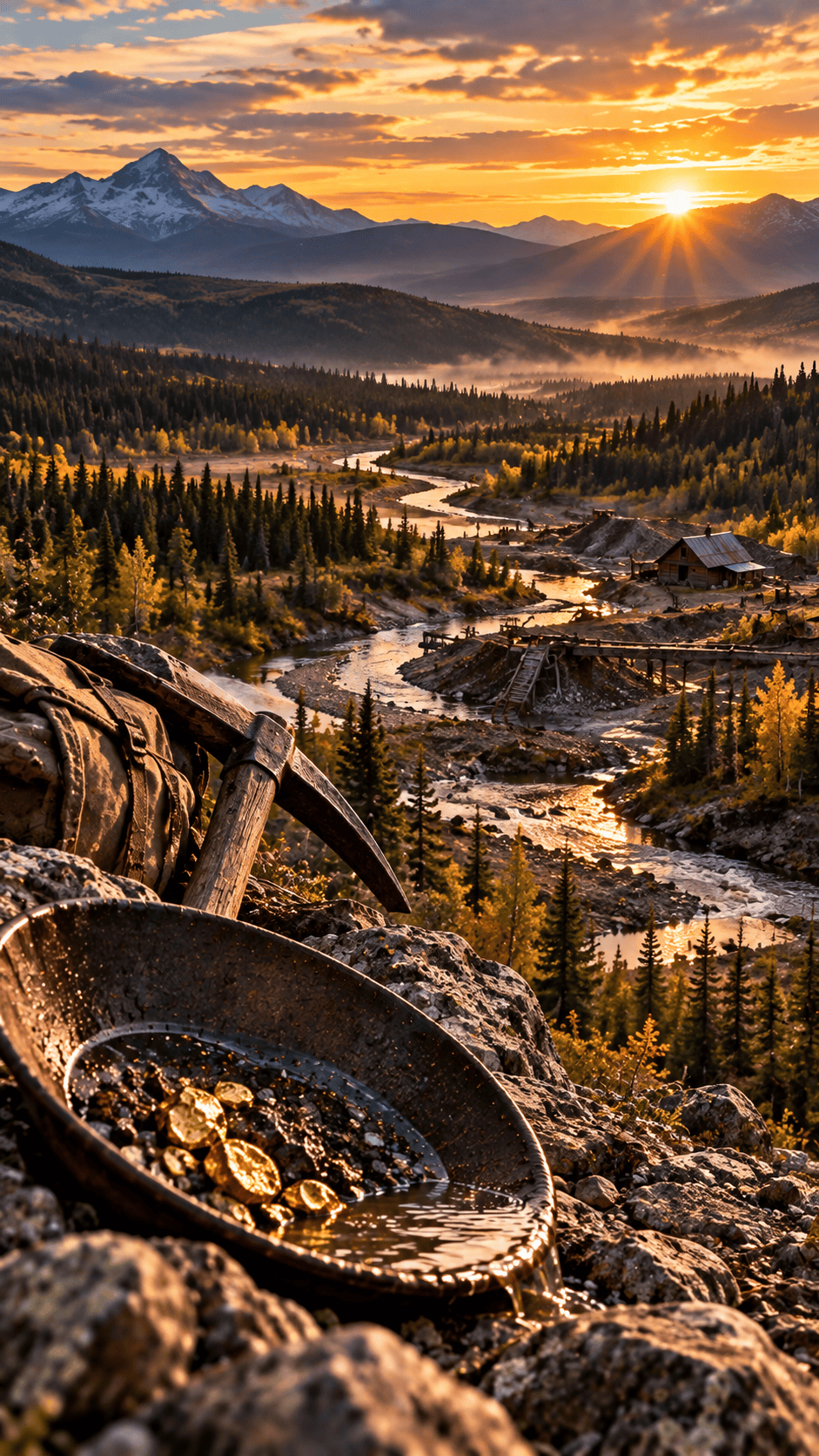
The oldest source tells it another way. In 1898, U.S. Geological Survey geologist Josiah Edward Spurr published a report on the Yukon gold district using notes he collected in 1896. About Chicken Creek, he wrote: “The creek is so named from the size of the gold, which is about that of chicken feed (corn)” (Anchorage Daily News).
So the name probably came from the gold, not the bird. Small nuggets the size of cracked corn gave the creek its name, and the camp took it from the creek. Later Alaska postal and place-name histories agree with that account (Anchorage Daily News).
Even Chicken’s most famous resident heard both versions. In her memoir “Tisha,” teacher Anne Hobbs Purdy wrote that her Uncle Arthur told the ptarmigan story, “Mert Atwood says this isn’t true,” and the name came from “gold nuggets as big as chicken corn” (Anchorage Daily News).
Nobody alive saw the naming, so nobody can say for sure. Our take: the gold story has the paperwork, and the ptarmigan story has the punchline.
A Creek Full of Gold
Chicken Creek is part of the Fortymile mining district, which runs between the Yukon and Tanana rivers along the Canadian border (Anchorage Daily News). Before 1896, one prospector, Bob Matheson, did most of the work on the creek. That spring, miners started drifting in from played-out creeks nearby (Anchorage Daily News).
By 1898, about 175 people lived in or near Chicken. A post office opened in the early 1900s, in 1903 according to the Anchorage Daily News and in 1902 according to Wikipedia. By 1906, about 400 people lived in the town and along the creeks around it (Anchorage Daily News).
Some of those buildings are still standing. A tour of the old town includes a roadhouse built in 1899, the last one left on the Taylor Highway, along with the Chicken Creek Hotel and other buildings from the early 1900s (ALASKA.ORG).
The Teacher Who Put Chicken on the Bookshelf
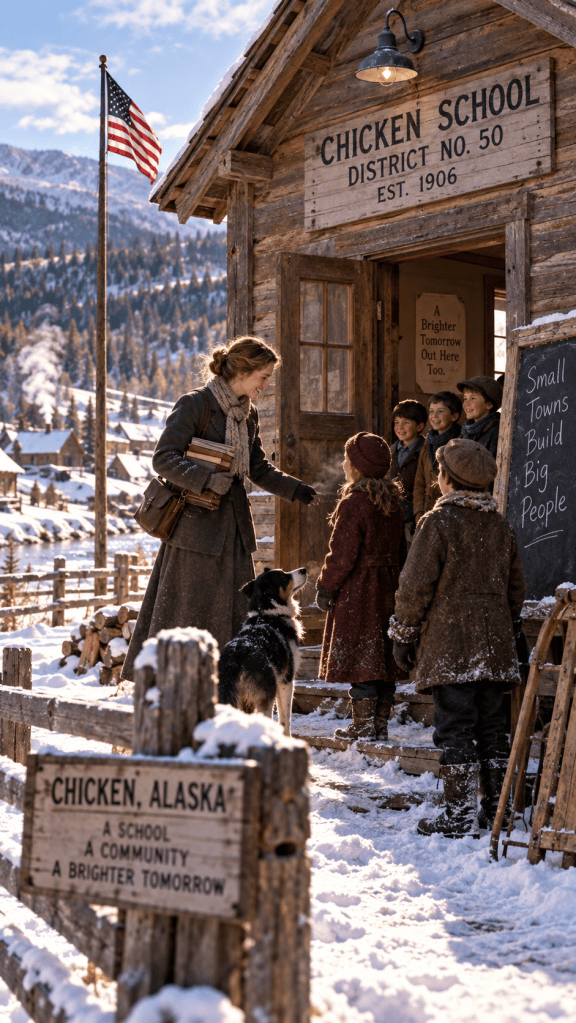
Chicken only had enough children for a school some of the time. Classes ran from 1925 to 1928 and again in 1950 and 1951 (ChickenAlaska.com).
Anne Hobbs arrived in 1927, riding in on a pack train out of Eagle (Anchorage Daily News). She taught the 1927–28 school year (ChickenAlaska.com). Decades later, as Anne Purdy, she worked with editor Robert Specht to turn that year into “Tisha,” named for what some of her students called her when they tried to say “teacher” (Goodreads).
The book is about more than a hard winter. It tells how the town turned against her when she treated local Native children as equals, and when she fell in love with a Native man (Kenton County Public Library). It found readers around the world. In Chicken, people liked it less (ChickenAlaska.com).
The schoolhouse is still there. It started out as the two-story Chicken Creek Hotel (ChickenAlaska.com).
The Bust
Gold camps rarely boom for long. By the 1930 census, Chicken had 20 residents (Wikipedia, citing the U.S. Census).
Then a company moved in. The Fairbanks Exploration Company began buying claims in 1939 and built a camp on Nora Bench. In 1953 it bought the whole townsite and made it a camp for its dredging operation (Bell’s Alaska).
The Machine That Ate the Creek
The dredge you can tour in Chicken today didn’t start here.
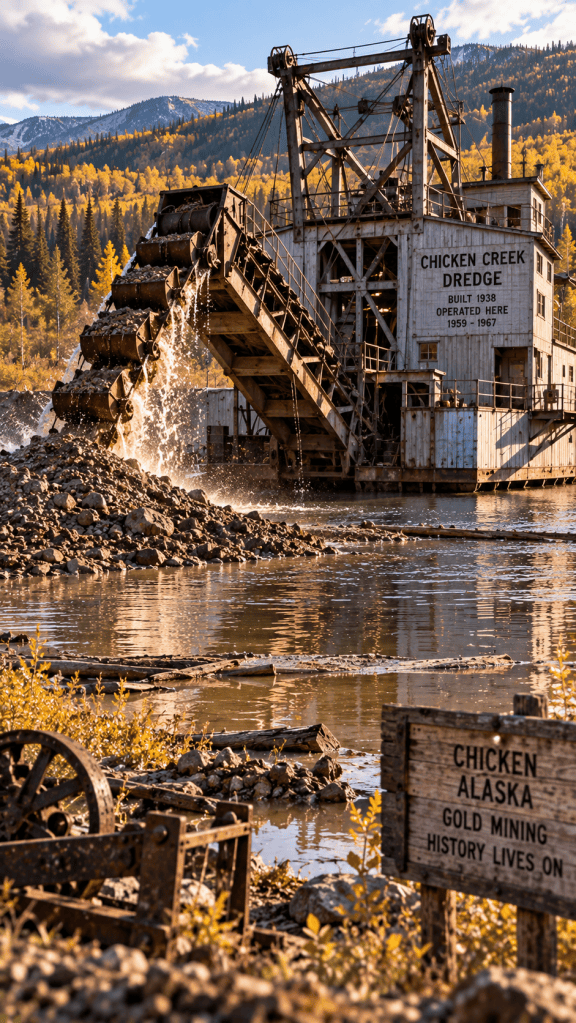
F.E. Company Dredge No. 4, now called the Pedro Dredge, was built in 1938 by the Yuba Manufacturing Company of San Francisco. It started digging on Pedro Creek near Fairbanks on July 11, 1938. On October 13, 1958, workers took it apart and trucked it several hundred miles to Chicken Creek (National Register nomination, National Park Service).
It started digging on Chicken Creek on September 13, 1959. Over the next eight years it worked 1,127 days and processed 2,551,052 cubic yards of gravel. That gravel gave up 75,377 troy ounces of gold bullion, worth $2,098,536 at the time (National Park Service).
On October 13, 1967, the company stopped mining for good. Labor and operating costs were high, and gold was still fixed at $35 an ounce, so dredging no longer paid (National Park Service).
The dredge sat for 31 years. In 1998, new owners moved the million-pound machine one mile, in one piece, on a trailer built on the spot (Chicken Gold Camp). It was added to the National Register of Historic Places in 2006 (ALASKA.ORG).
Why It’s Still Worth the Turn
Chicken never fully emptied out. Small miners stayed. Travelers started showing up to see what was left. The town that got its name from gold now makes much of its living from the name itself.
At the Mile 66 turnoff, Downtown Chicken has the Chicken Creek Café and Saloon, gas and gold panning. Chicken Gold Camp & Outpost has the Pedro Dredge, a café, cabins and camping (The MILEPOST). Walking tours of the historic town, including Tisha’s schoolhouse, run in the summer (Bell’s Alaska).
Each June, the gold camp hosts Chickenstock, which bills itself as “Music on Top of the World.” Next year’s dates are June 10–12, 2027 (Chickenstock Music Festival). The festival’s best-known tradition is the Peep Drop, when a plane drops marshmallow chicks over the crowd (Webcenter Fairbanks).
If You Go
- When: The Taylor Highway is open from about April to mid-October. The state doesn’t maintain it in winter, so check Alaska 511 before you go (Alaska DOT&PF).
- Where: Turn north off the Alaska Highway at Tetlin Junction, about 12 miles southeast of Tok. Chicken is at about Mile 66 (The MILEPOST).
- Road: The first 60 miles or so are paved. After that it’s gravel, which can be soft or rough (Alaska DOT&PF).
- Keep going: Past Chicken, the road splits. One branch goes to the Top of the World Highway and Dawson City, Yukon. The other goes to historic Eagle on the Yukon River (The MILEPOST).
Chicken was named for gold the size of chicken feed. Or maybe for a bird nobody could spell. Either way, more than a century later, the town is still there for anyone who takes the turn.
You passed the town. We took the exit.
Made with AI: the narrators and scenes in our videos, and the illustrations in this article, are AI-generated. The history comes from the sources linked above.
Sources
- Anchorage Daily News, “How did the tiny Alaska village of Chicken get its name?”
- National Park Service, National Register nomination for F.E. Company Dredge No. 4
- Alaska DOT&PF, Taylor Highway
- The MILEPOST, Taylor Highway
- Wikipedia, Chicken, Alaska (census table)
- ChickenAlaska.com, Tisha
- Chicken Gold Camp, Pedro Dredge
- ALASKA.ORG, Pedro Dredge No. 4
- ALASKA.ORG, Chicken (Mile 65.3)
- Bell’s Alaska, Chicken
- Kenton County Public Library, Tisha catalog record
- Goodreads, Tisha
- Chickenstock Music Festival
- Webcenter Fairbanks, Chickenstock


Leave a Reply