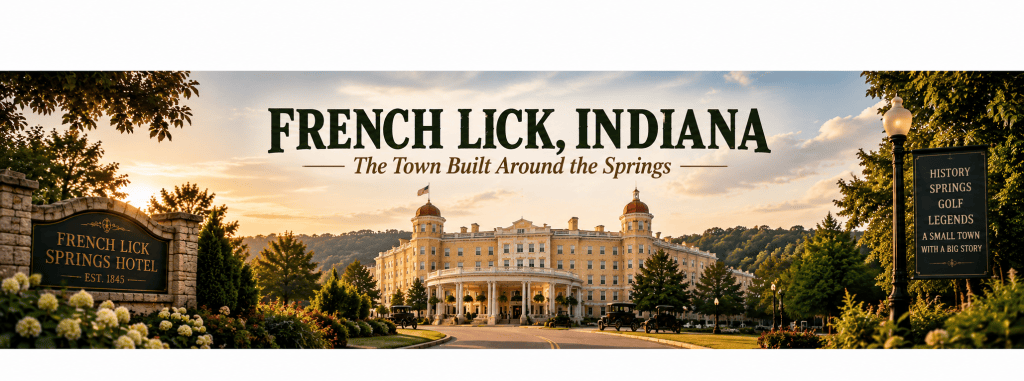
A tiny southern Indiana town. Mineral water bubbling from beneath the ground. Grand hotels rising among the hills. And visitors arriving from across America.
Today, French Lick is known for its historic resort, golf, casino and its connection to basketball legend Larry Bird.
But long before any of that, people were making the journey to this corner of Orange County for something coming out of the ground.
Mineral springs helped transform an isolated area of southern Indiana into one of the country’s best-known resort destinations.
And one of the most remarkable parts of the story is this:
The hotel was here before French Lick was officially a town.
Watch the Story
Prefer the quick version first? Watch our French Lick, Indiana — Part 1 video on TikTok, then come back here for the history behind the places and stories featured in the video.
▶ Watch French Lick — Part 1 on TikTok
Before French Lick Was French Lick
Long before tourists arrived carrying suitcases, animals were already being drawn to the salt and mineral deposits of southern Indiana.
Early trails through the region were associated with buffalo traveling toward salt licks. As settlers moved into Orange County, the area’s mineral-rich springs began attracting human attention as well.
At first, the interest wasn’t tourism.
It was salt.
In 1826, Indiana authorized exploration of the area in hopes that commercially useful salt deposits could be found. Salt was extremely valuable for preserving food, but the water ultimately proved too low in salinity to make large-scale salt production practical.
What looked like a failed resource would eventually become valuable for an entirely different reason.
Dr. William A. Bowles acquired land containing the mineral springs.
Across America, mineral-spring resorts were becoming fashionable. People traveled to these destinations believing that bathing in or drinking mineral water could help treat a wide variety of illnesses.
Bowles saw an opportunity.
A Hotel Before There Was a Town
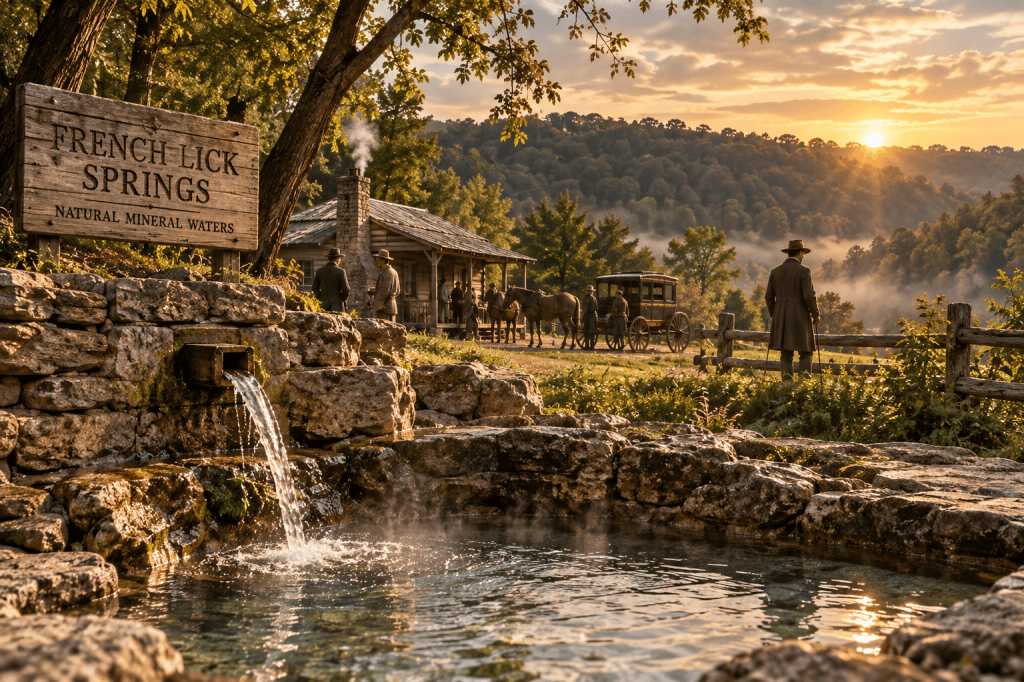
In 1845, Dr. William Bowles established the French Lick Springs Hotel.
The first hotel was nothing like the enormous yellow-brick resort visitors see today.
It was a three-story wooden building in the southern Indiana countryside.
Guests arrived by stagecoach and buggy and came primarily for the mineral springs. Bowles promoted the water’s supposed health benefits, and visitors spent their time relaxing, socializing and drinking the water.
The hotel initially operated seasonally, with visitors arriving during what became known as the “watering season.”
Travel wasn’t quick in the mid-1800s.
A trip to French Lick could require considerable time and effort, which meant guests often stayed much longer than today’s weekend travelers.
And gradually, word spread.
There was something happening among the hills of Orange County.
Then came an interesting reversal of the way towns usually develop.
French Lick wasn’t platted until 1857.
Bowles’ hotel had already been attracting guests for more than a decade.
In a very real sense, the resort came first.
The town grew around it.
The Water That Put French Lick on the Map
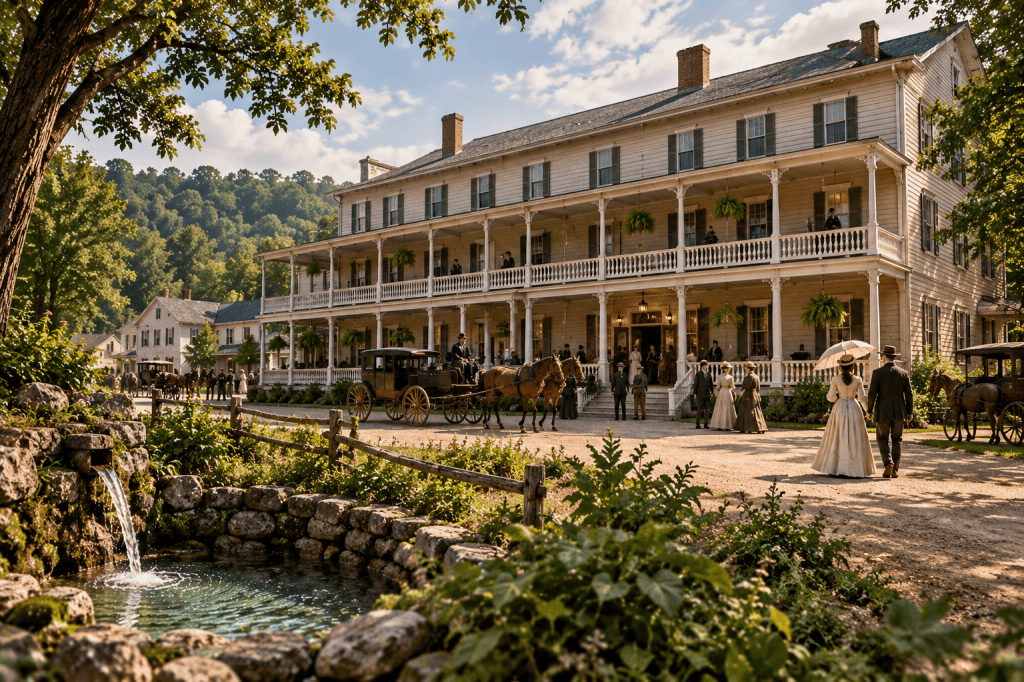
The springs remained at the center of French Lick’s identity.
Eventually one of them would become associated with a name recognized far beyond Indiana:
Pluto.
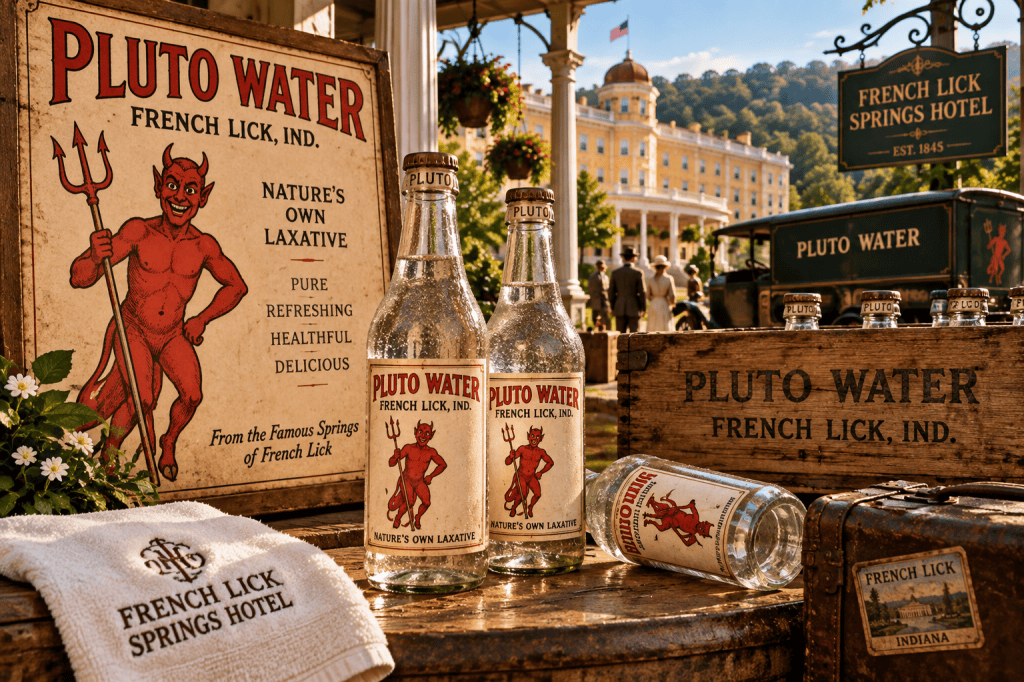
The mineral water was marketed as Pluto Water, using an unforgettable red devil-like figure representing Pluto, the Roman god of the underworld.
Advertisements made sweeping claims about what the water could do for the human body — claims that reflected an era when mineral waters and patent medicines were commonly marketed as remedies for numerous ailments.
Whatever its actual medical value, the marketing was enormously effective.
And eventually, visitors didn’t have to travel to French Lick to experience it.
French Lick began sending the water to them.
Bottles carrying the words “Pluto Water” and “French Lick, Indiana” were distributed around the country.
A product that began as water bubbling from beneath a small southern Indiana town had become part of a national brand.
But French Lick’s transformation was only beginning.
At the start of the 20th century, a businessman and political powerhouse arrived who would push the resort into an entirely different league.
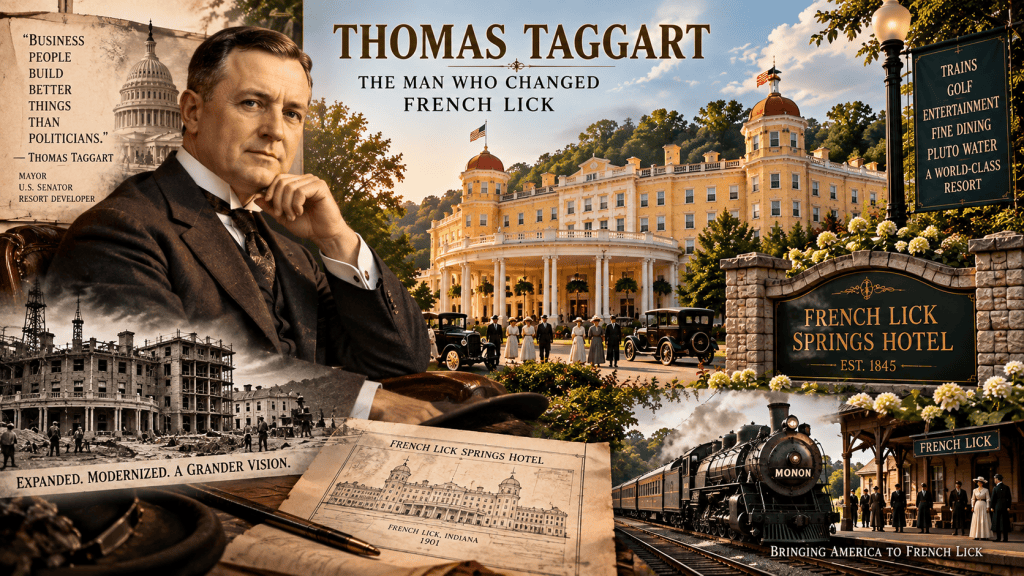
His name was Thomas Taggart.
The Man Who Changed French Lick
Thomas Taggart had traveled an unlikely road himself.
Born in Ireland in 1856, he immigrated to the United States as a child and eventually made his way to Indianapolis.
He rose from the restaurant and hotel business into politics, becoming one of Indiana’s most influential Democratic political figures.
Taggart served three terms as mayor of Indianapolis and became a major force within the state and national Democratic Party. He later briefly represented Indiana in the United States Senate.
But his impact on French Lick came through business.
In 1901, Taggart and a group of investors formed the French Lick Hotel Company and purchased French Lick Springs Hotel.
Taggart saw more than an aging mineral-springs hotel.
He saw the possibility of creating a world-class resort.
He enlarged and modernized the property.
New guest areas appeared.
The mineral springs were improved.
A new bottling facility was built.
The distinctive yellow French Lick brick helped give the resort the appearance still associated with it today.
But improving the hotel wasn’t enough.
Taggart needed to solve one of French Lick’s biggest problems.
How do you bring large numbers of people to a resort hidden among the hills of southern Indiana?
The Railroad Brings America to French Lick
Rail service had already transformed travel in the region, but Taggart pushed the connection even further.
He encouraged the Monon Railroad to construct a special spur serving French Lick Springs Hotel.
Passenger trains could bring visitors from Chicago and elsewhere directly to the resort.
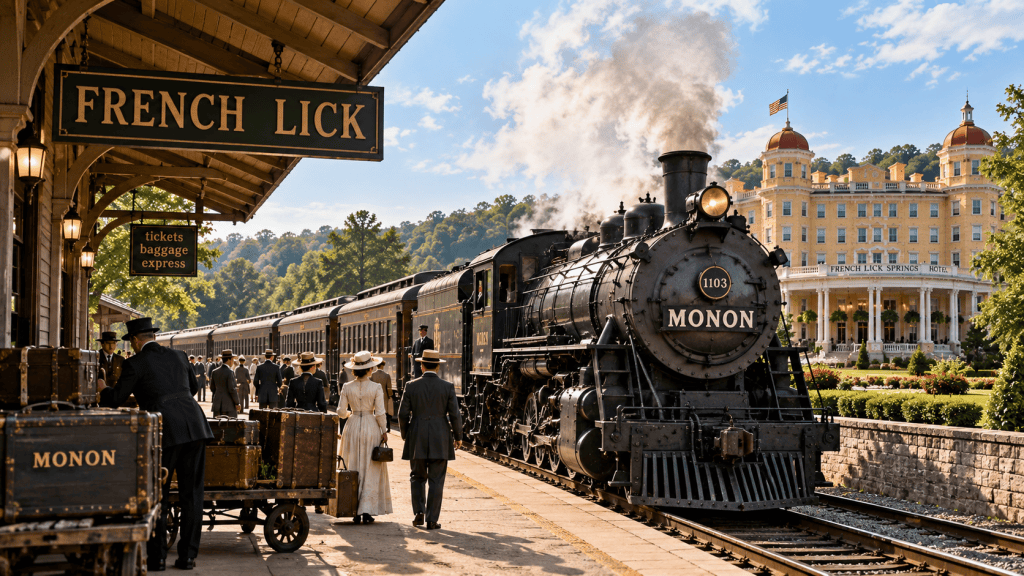
Imagine arriving during French Lick’s early-20th-century heyday.
After hours aboard a train, instead of stepping into a crowded city station, you arrived at a sprawling resort surrounded by the rolling hills of southern Indiana.
Bellmen handled luggage.
Guests entered elegant public rooms.
Outside were gardens and mineral springs.
Entertainment, recreation and eventually championship golf waited nearby.
Transportation helped turn what had once been French Lick’s biggest weakness — its isolated location — into part of its appeal.
You weren’t simply staying at a hotel.
You were escaping somewhere.
And Taggart continued building an experience around that idea.
Pluto Water Goes National
Taggart understood something else:
People might visit French Lick once or twice.
But a product carrying the French Lick name could reach them every day.
He expanded the bottling operation for Pluto Water and promoted it nationally.
The product’s advertising was impossible to mistake.
A bright red Pluto character, complete with horns, tail and trident, became its trademark.
The mascot appeared on advertising and promotional material, while bottles of mineral water carried the French Lick name into homes and stores far beyond Indiana.
The Indiana Historical Society notes that Pluto Water was bottled in French Lick and sold across the country while being advertised as a cure for a multitude of ailments.
Today, those medical claims belong to another era.
But as marketing?
Pluto was unforgettable.
A small Indiana resort had created one of the most distinctive brands of the mineral-water age.
A Resort in the Middle of Rural Indiana
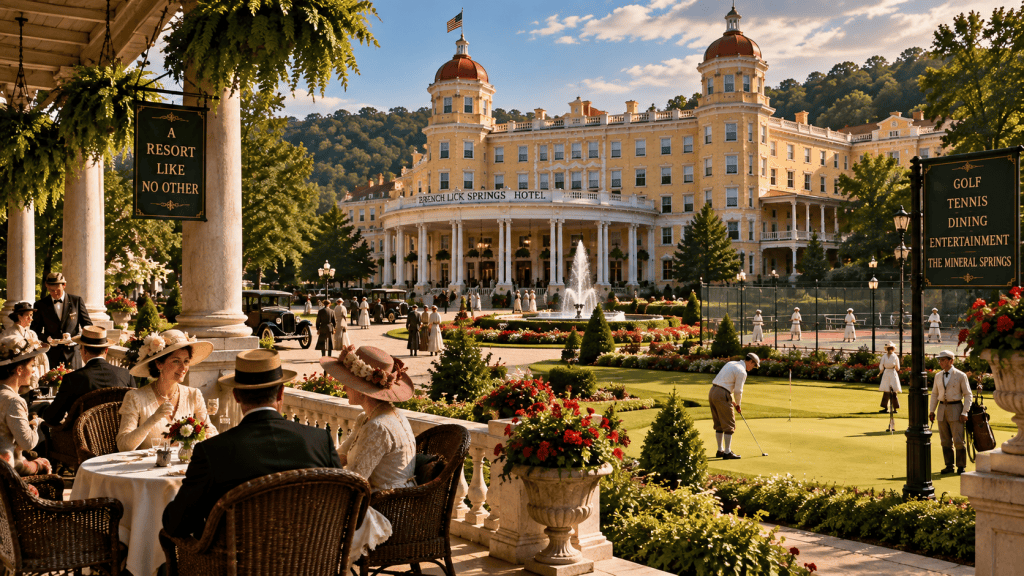
By the early 20th century, visitors weren’t coming to French Lick simply to drink mineral water.
They came for the entire experience.
Golf.
Tennis.
Bowling.
Billiards.
Horseback riding.
Dining.
Dancing.
Gardens.
Entertainment.
Even baseball became part of the resort atmosphere, with major-league teams among those that trained in the area during the resort era.
Taggart also helped bring modern infrastructure beyond the hotel itself.
Under his ownership, improvements included electricity, a freshwater system and trolley transportation connecting the area.
The relationship between the resort and community had become almost impossible to separate.
The springs created the attraction.
The hotel helped create the town.
And the success of the resort was helping modernize the community around it.
Where Business and Politics Mixed
There was another reason influential people knew French Lick.
Thomas Taggart himself.
Taggart wasn’t merely a hotel owner who happened to be involved in politics.
He was a significant figure in the Democratic Party.
He served as chairman of Indiana’s Democratic organization, joined the Democratic National Committee and chaired the national committee during the 1904 presidential campaign.
French Lick Springs Hotel consequently became a natural gathering place for politicians, business leaders and other influential guests.
Its reputation as a political meeting ground grew.
One of the most notable gatherings came in 1931, when the National Governors’ Conference met at French Lick.
Among the attendees was New York Governor Franklin D. Roosevelt.
Roosevelt used the gathering as part of his effort to build support before seeking the Democratic presidential nomination.
The following year, he secured the nomination and won the presidency.
Think about that for a moment.
National political figures were gathering and strategizing in a town that had begun less than a century earlier around a mineral spring and a wooden hotel.
French Lick had traveled a long way from its watering-season beginnings.
But politics wasn’t the only activity associated with the resort town.
There was another attraction that visitors knew about.
And its history was considerably more complicated.
French Lick’s Not-So-Secret Gambling Era
Gambling became deeply intertwined with the history of French Lick and nearby West Baden.
Casinos and gaming establishments operated in the Springs Valley despite Indiana laws restricting gambling.
The National Register documentation for French Lick Springs Hotel describes repeated controversy over gambling during Taggart’s era, including accusations, raids and legal battles.
Exactly who controlled which gambling operations — and when — was sometimes disputed even at the time.
But there is little question that gambling became part of French Lick’s reputation.
Visitors could come for mineral water, recreation, socializing and golf while finding gambling nearby as well.
For years, enforcement was inconsistent.
Then came 1949.
A new state administration had pledged to stop gambling in French Lick.
During Derby Weekend that year, Indiana State Police carried out a major crackdown.
Hotel guests returning from the Kentucky Derby reportedly found the doors of local gambling establishments chained shut.
Known casino gambling in the Springs Valley had come to an end.
At least for that era.
But before French Lick reached that turning point, two other pieces of its history would leave surprisingly long legacies.
One began with a chef who reportedly ran out of oranges.
The Breakfast Drink Born in French Lick
In 1917, Chef Louis Perrin was working at French Lick Springs Hotel when he encountered a problem.
According to the history preserved by the resort, Perrin ran out of oranges one morning and couldn’t serve the customary orange juice to guests.
He needed another juice.
So he turned to tomatoes.
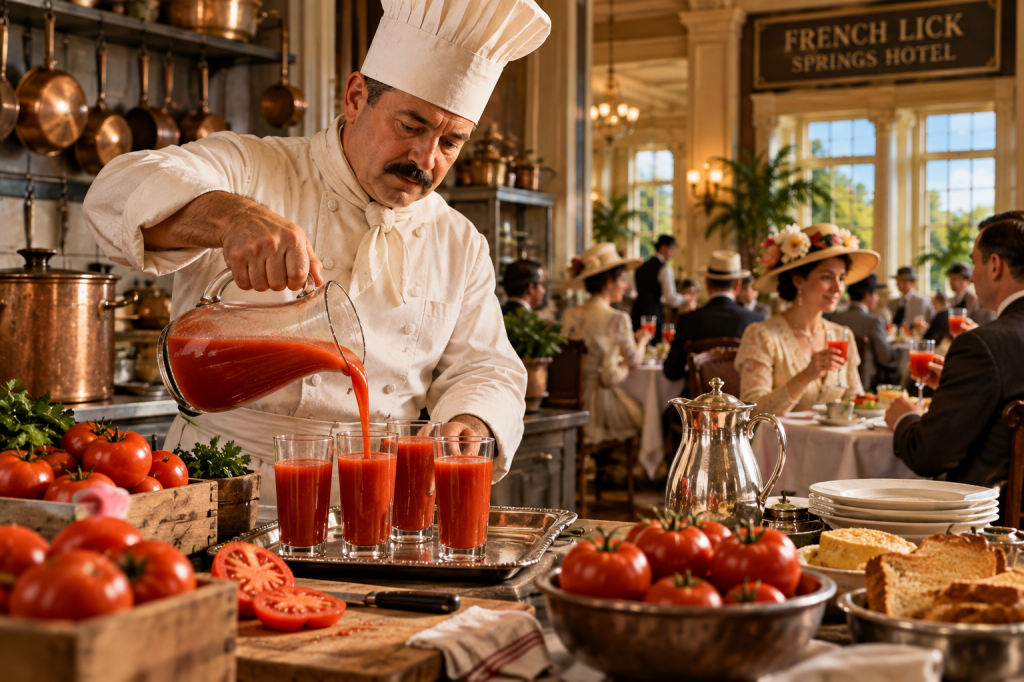
Perrin squeezed them and created a substitute drink for breakfast.
The experiment caught on.
The resort credits Perrin with being the first to serve tomato juice as a drink, and the beverage became associated with French Lick before spreading much more widely.
More than a century later, French Lick Resort still commemorates the story.
It’s one of those strange pieces of local history that sounds almost too perfect.
A drink now found in grocery stores, restaurants and airplane beverage carts around the world traces part of its popular history to a chef improvising breakfast in southern Indiana.
And in that same year — 1917 — another project was beginning that would put French Lick into the history of professional sports.
A Championship Golf Course in the Hills
Thomas Taggart had already embraced golf as part of the resort experience.
In 1907, he hired golf-course designer Tom Bendelow to develop a championship course.
A decade later, French Lick went even bigger.
In 1917, renowned golf architect Donald Ross was hired to design another course on the hills southwest of the hotel.
Ross would become one of the most celebrated golf-course architects in American history.
His French Lick course, locally known as the Hill Course, took advantage of the rolling terrain and featured the bunkering and strategic challenges associated with Ross designs.
Then, in 1924, French Lick landed one of golf’s major championships.
The PGA Championship came to the Donald Ross Course.
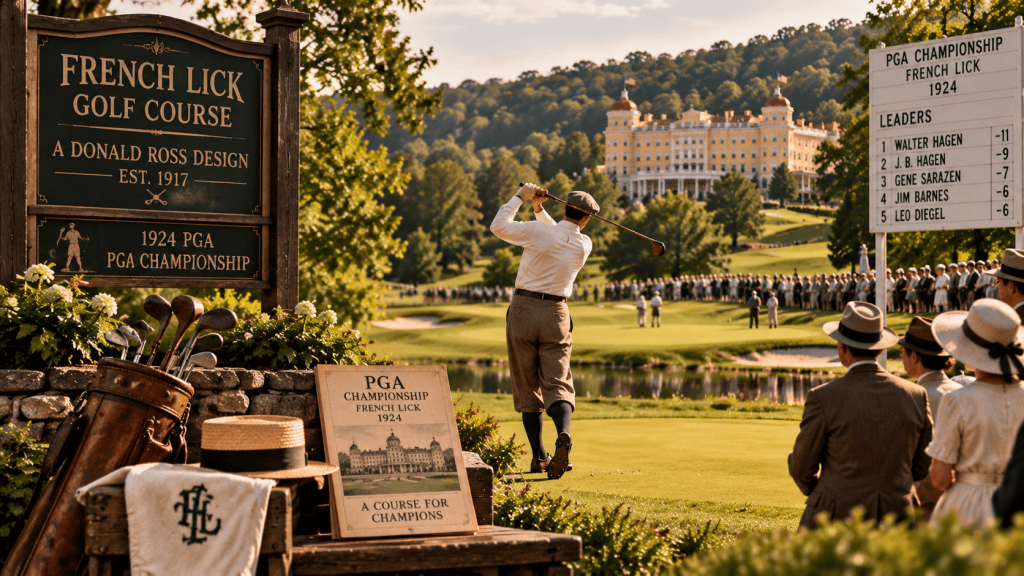
Walter Hagen defeated Jim Barnes, 2 up, in the championship match.
It was Hagen’s second PGA Championship victory — and the beginning of an extraordinary run of four consecutive PGA Championship titles from 1924 through 1927.
Once again, French Lick had pulled the national spotlight toward a small town in southern Indiana.
The Golden Age
By the 1920s, French Lick had become something almost unimaginable compared with the place Dr. Bowles had known in 1845.
Trains delivered visitors.
Pluto Water traveled around the country.
Politicians gathered at the hotel.
Professional golfers competed on the hills above town.
Guests danced, dined, gambled, played golf and spent days or weeks enjoying the resort atmosphere.
And only about a mile away stood French Lick’s great rival:
West Baden Springs Hotel.
Its enormous domed atrium gave the Springs Valley not one, but two extraordinary resort hotels.
For a time, this small corner of Orange County occupied a remarkable place in American tourism.
But golden ages rarely last forever.
When the Road Began to Change
The forces that helped create French Lick’s success were changing.
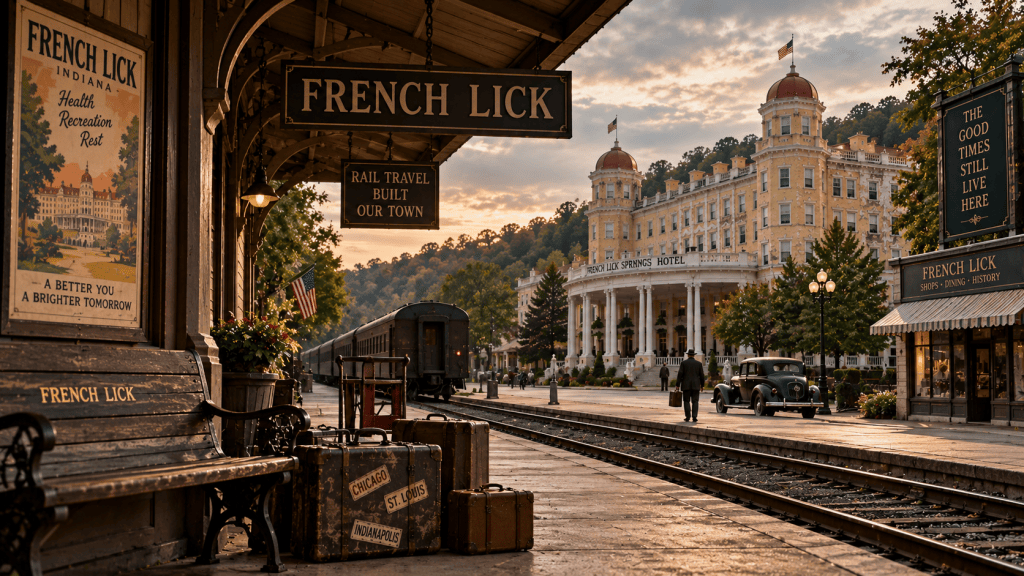
Americans increasingly traveled by automobile instead of passenger train.
Modern medicine changed attitudes toward mineral-water cures.
Vacation habits changed.
The Great Depression devastated luxury travel.
Thomas Taggart died in 1929.
His son, Thomas D. Taggart, continued operating French Lick Springs Hotel through the Depression and World War II before selling it in 1946.
Then the 1949 gambling crackdown removed another piece of the old resort culture.
French Lick Springs Hotel survived.
But the world around it was no longer the world that had created its spectacular rise.
And across the valley, the situation would eventually become far more serious.
One of America’s most remarkable hotels would close.
Its grand rooms would serve entirely different purposes.
Years of deterioration would follow.
And eventually, part of the building would come crashing down.
It looked as though one of the greatest chapters in French Lick’s history might disappear forever.
But French Lick’s story wasn’t finished.
Keep Exploring
French Lick had already survived enormous change.
But what happened next may be even more remarkable than how the town became famous in the first place.
In Part 2, we follow French Lick and West Baden through decline, the dramatic collapse that became a symbol of just how close one of the valley’s great landmarks came to being lost, and the extraordinary preservation effort that helped give the area another chance.
[LINK: French Lick, Indiana Part 2 — The Town That Found Another Road Forward]
Follow The Town You Passed as we explore small towns, forgotten places, local legends and unexpected stories hiding along the roads most of us drive right past.
You passed the town. We took the exit.

 The Town You Passed
Leave a comment