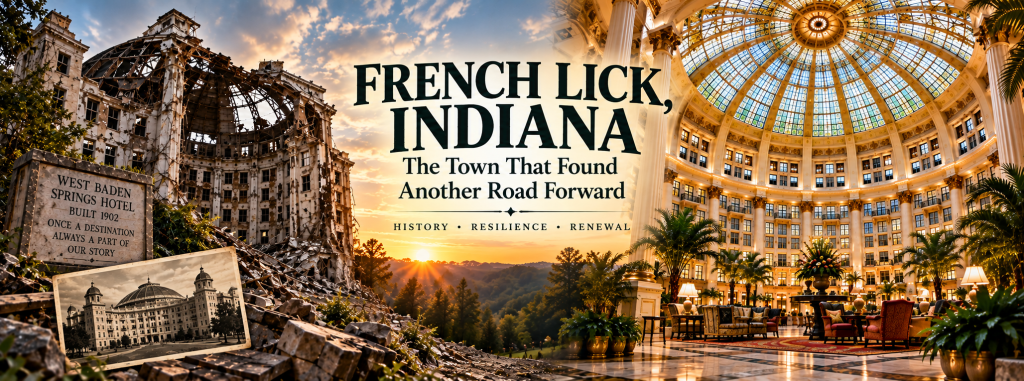
French Lick had spent decades building something extraordinary.
Mineral springs brought the first visitors. Pluto Water carried the town’s name across America. Trains delivered vacationers by the thousands. Grand hotels, gambling, championship golf and powerful guests transformed a tiny southern Indiana community into one of America’s most unlikely resort destinations.
But the world that created French Lick was changing.
And just one mile down the road, one of America’s most remarkable hotels was about to begin a fall that would eventually leave part of it lying in ruins.
For decades, the enormous dome of West Baden Springs Hotel had symbolized the grandeur of the Springs Valley.
Eventually, part of the building would come crashing to the ground.
And for a time, there was no guarantee it would ever rise again.
Watch the short version: See French Lick’s remarkable fall and comeback, then keep reading for the full story.
When the Golden Age Ended
By the 1920s, French Lick and neighboring West Baden had become two of the Midwest’s great resort destinations.
But almost everything that had fueled their rise was beginning to change.
Americans increasingly traveled by automobile instead of passenger train.
Modern medicine was replacing the belief that mineral water could cure a long list of illnesses.
Vacation habits changed.
Then came the stock market crash of 1929 and the Great Depression.
The lavish resort culture that had flourished in the Springs Valley suddenly faced a very different America.
French Lick Springs Hotel managed to keep operating.
Its famous neighbor wasn’t as fortunate.
The Eighth Wonder Goes Quiet
Only about a mile from French Lick Springs Hotel stood a building unlike almost anything else in America.
West Baden Springs Hotel.
Its enormous domed atrium had earned the hotel a nickname:
The Eighth Wonder of the World.
When the present hotel opened in 1902, its massive free-spanning dome was an engineering marvel. Beneath it was an immense circular atrium surrounded by guest rooms, balconies and elaborate public spaces.
Guests once gathered beneath the dome for music, conversation and entertainment.
But after the stock market crash and the decline of the mineral-springs resort era, West Baden struggled.
The hotel closed in 1932.
It appeared that one of America’s great resort hotels had reached the end of its story.
Instead, the building began living several completely different lives.
From Luxury Hotel to Seminary
West Baden’s next occupants weren’t vacationers.
They were Jesuits.
The property passed to the Society of Jesus, which converted the enormous former resort into a seminary.
The transformation was dramatic.
A building created for wealthy travelers, elaborate dinners and resort entertainment became a place of religious education and study.
Many of the decorative elements from the hotel’s resort days disappeared or were altered.
But there was an unexpected benefit.
The building remained occupied.
And that helped keep it standing.
For roughly three decades, the former luxury hotel served the Jesuits before another chapter began.
A College Beneath the Dome
In the 1960s, the property changed hands again.
Northwood Institute moved into West Baden and operated a college there.
Once again, the enormous building found a purpose.
Students walked hallways that had once been filled with resort guests. Classrooms occupied spaces inside one of the most unusual hotel buildings ever constructed in the United States.
But Northwood eventually left.
By the early 1980s, West Baden Springs Hotel was empty.
And this time, there wasn’t another institution waiting to move in.
The building that had survived by constantly finding another purpose suddenly had none.
A Hotel Without a Future
An empty building can deteriorate remarkably quickly.
An empty building the size of West Baden Springs Hotel can become an enormous problem.
Water found its way inside.
Windows were broken.
Plaster deteriorated.
Vegetation began reclaiming parts of the property.
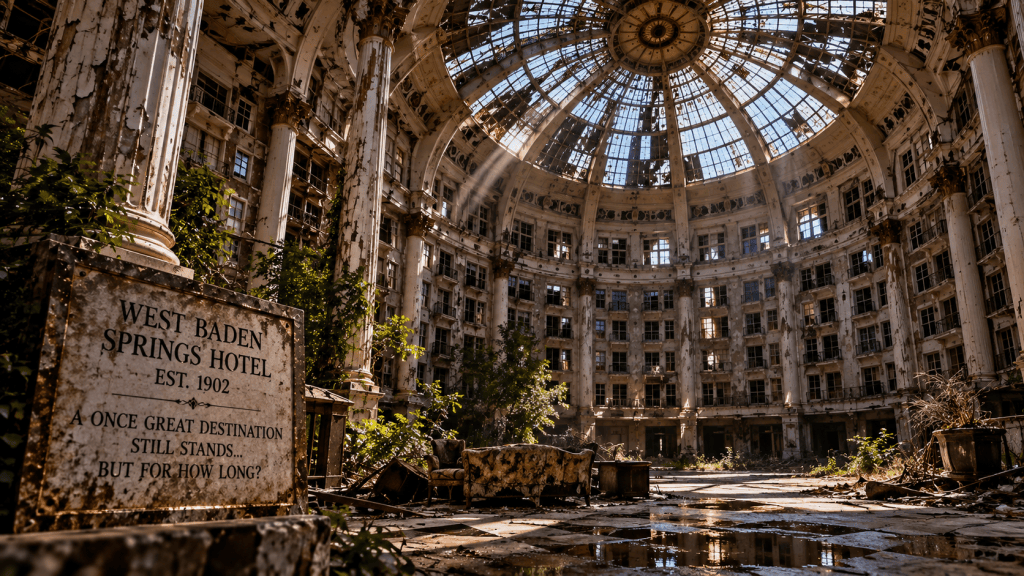
Years of deferred maintenance accumulated.
The hotel changed ownership and became tangled in financial problems and failed redevelopment plans.
By the end of the 1980s, conditions had deteriorated so badly that the building was closed to the public for safety reasons.
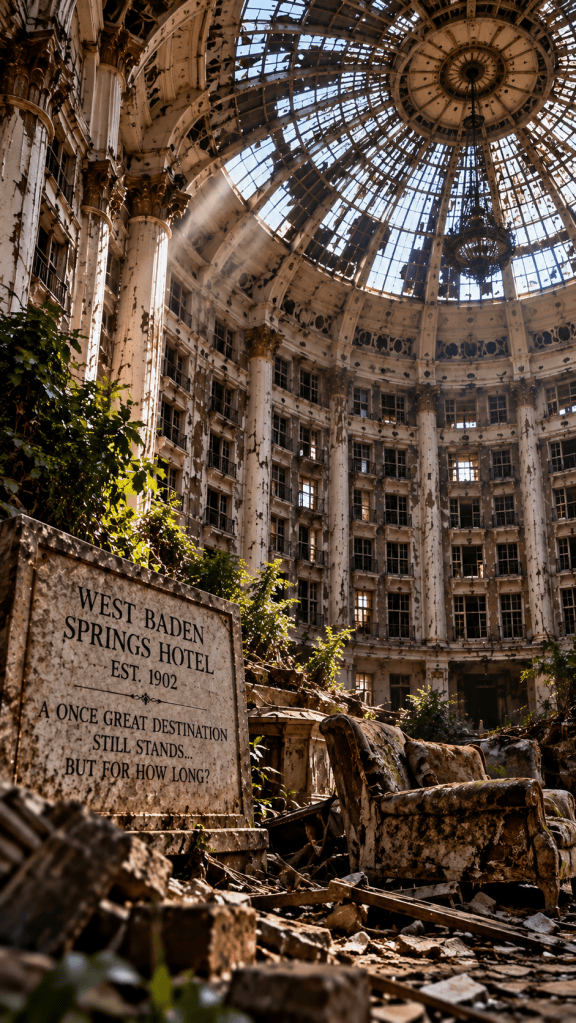
The enormous dome still towered over the valley.
But beneath it, one of America’s architectural treasures was slowly coming apart.
Then came January 1991.
The Day Part of West Baden Fell
Years of deterioration had weakened the building.
During the winter of 1991, ice and water accumulated on portions of the structure.
Then part of the hotel gave way.
A roughly 180-foot-long, six-story section of the exterior wall collapsed.
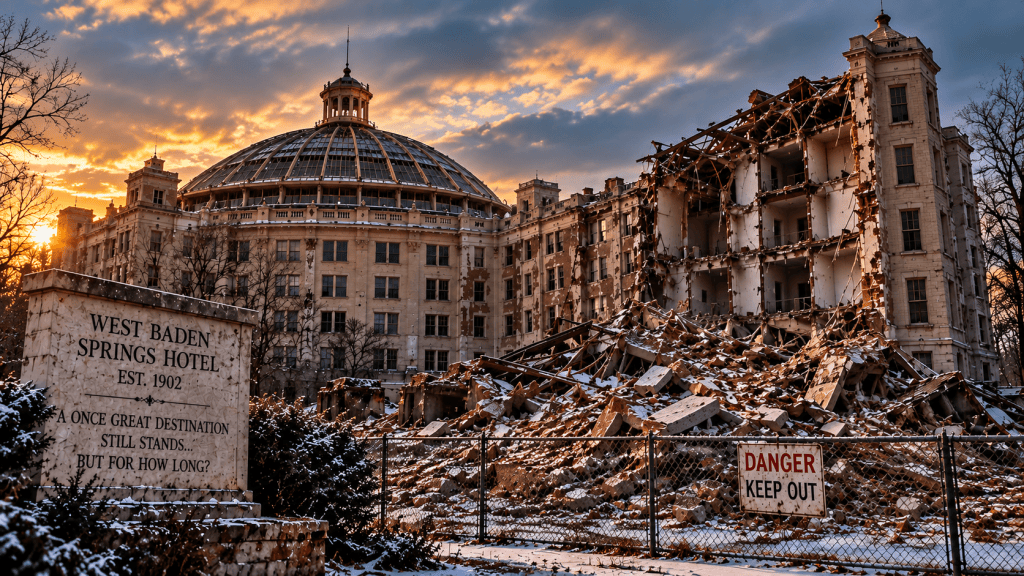
Brick, timber and sections of the building crashed into a massive pile of debris.
The photographs are startling.
This wasn’t simply peeling paint or broken windows anymore.
A substantial piece of the building was gone.
West Baden Springs Hotel had reached a point where losing the entire structure no longer seemed impossible.
A hotel once promoted as the Eighth Wonder of the World now had part of its exterior lying in rubble.
But the collapse also made something impossible to ignore:
If somebody didn’t act, West Baden might disappear.
Saving Enough to Have a Future
Preservationists had already recognized West Baden’s importance.
Now the situation was urgent.
Indiana Landmarks became deeply involved in trying to stabilize the property and preserve the possibility that someone might eventually restore it.
In 1992, stabilization work was undertaken to prevent additional deterioration.
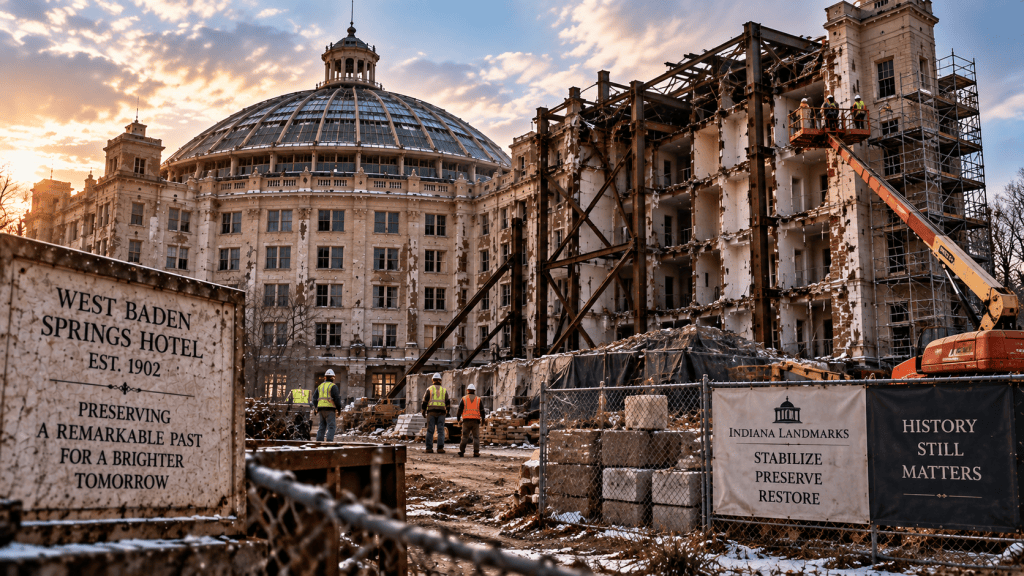
It wasn’t a glamorous restoration.
There were no luxurious hotel rooms being reopened.
No grand reopening ceremony.
The immediate objective was much simpler:
Keep the building standing.
Because before West Baden could be restored, it first had to survive.
Then the Cooks Arrived
The turning point came in the 1990s.
Bill and Gayle Cook of Bloomington had already developed a reputation for preserving historic Indiana buildings.
Their family business had been built in the medical-device industry, but historic preservation had become another passion.
In 1996, Indiana Landmarks announced its purchase of West Baden Springs Hotel and a partnership with the Cook family to rescue and restore the property.
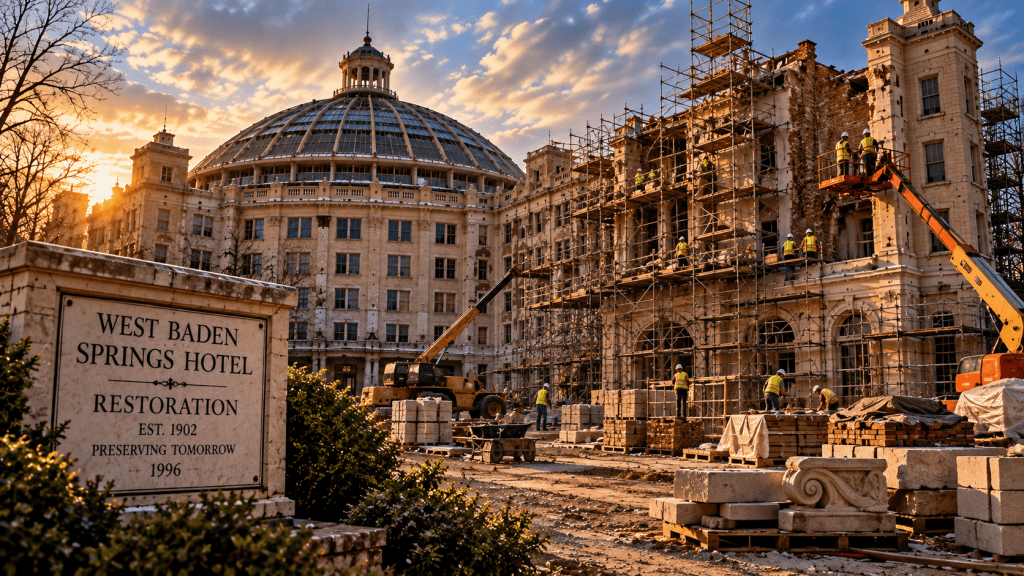
What they inherited was daunting.
Part of the exterior had collapsed.
Other portions remained structurally vulnerable.
The interior had suffered years of decay and vandalism.
Vegetation had taken over portions of the grounds.
Restoring West Baden wouldn’t simply require decorating an old hotel.
It would require rebuilding parts of it.
Bringing the Dome Back to Life
The restoration became enormous.
Crews reinforced the building with millions of pounds of structural steel.
Layers upon layers of old roofing material were removed.
Brickwork was repaired.
Windows were restored.
Decorative details were recreated.
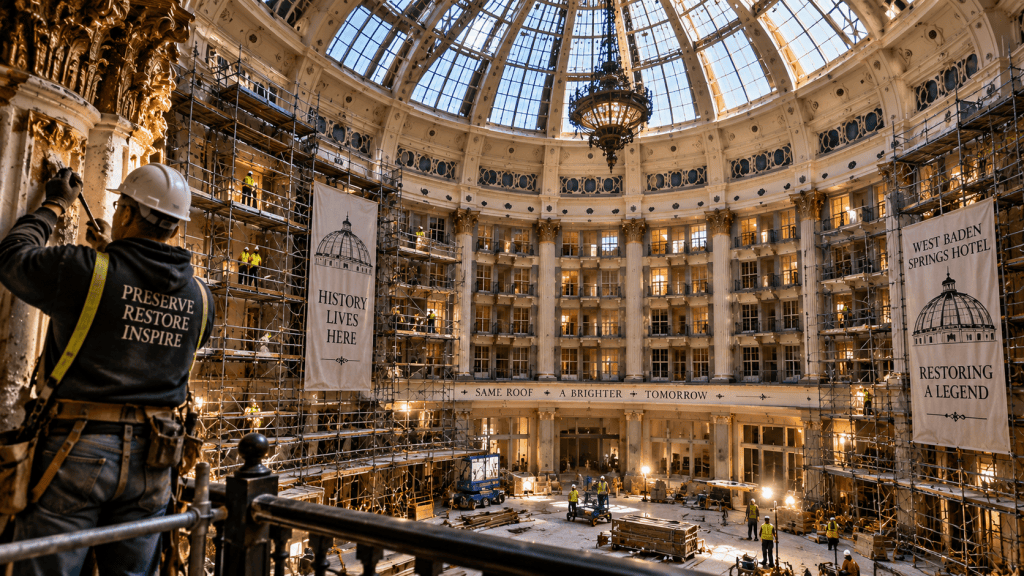
The atrium slowly began looking less like an abandoned building and more like the extraordinary space travelers had experienced generations earlier.
And as the work progressed, something unexpected happened.
People came just to see it.
Indiana Landmarks began offering tours while restoration was still underway.
Visitors walked through a building that wasn’t yet a functioning hotel simply because they wanted to witness its transformation.
West Baden was becoming a destination again before anyone could even spend the night there.
But saving one magnificent building wasn’t enough to revive the entire resort community.
French Lick needed something bigger.
French Lick Springs Had Its Own Problem
Unlike West Baden, French Lick Springs Hotel had remained open.
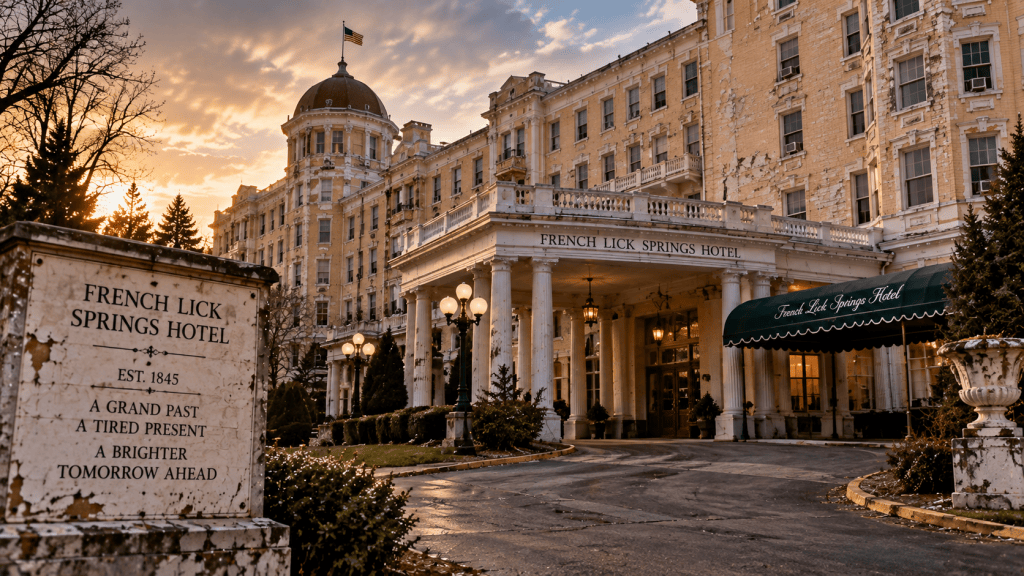
But survival wasn’t the same thing as prosperity.
After the Taggart era ended, the hotel passed through multiple owners.
Renovations came and went.
Parts of the property were modernized.
Other parts aged.
By the turn of the 21st century, Indiana Landmarks described the once-grand hotel as having grown tired and shabby.
The two famous hotels now represented different versions of the same problem.
West Baden needed to be brought back from near ruin.
French Lick Springs needed major investment if it was going to remain viable.
The community needed an economic engine capable of supporting both.
Ironically, part of the answer involved something French Lick had once been famous for.
Gambling.
Gambling Returns — This Time Legally
For generations, gambling had operated around French Lick despite being illegal under Indiana law.
That era effectively ended with the famous crackdown of 1949.
More than half a century later, the conversation was completely different.
Indiana had legalized casino gambling under regulated conditions, and supporters in the French Lick area sought authorization for a casino that they argued could help revive the region’s tourism economy.
The community, preservation advocates and business interests worked for years toward bringing a casino license to Orange County.
Eventually, the project moved forward with Indiana’s final available casino license.
In 2005, state officials signed the agreement authorizing the French Lick casino project.
But the casino wasn’t being developed in isolation.
It was tied to a much larger resort investment.
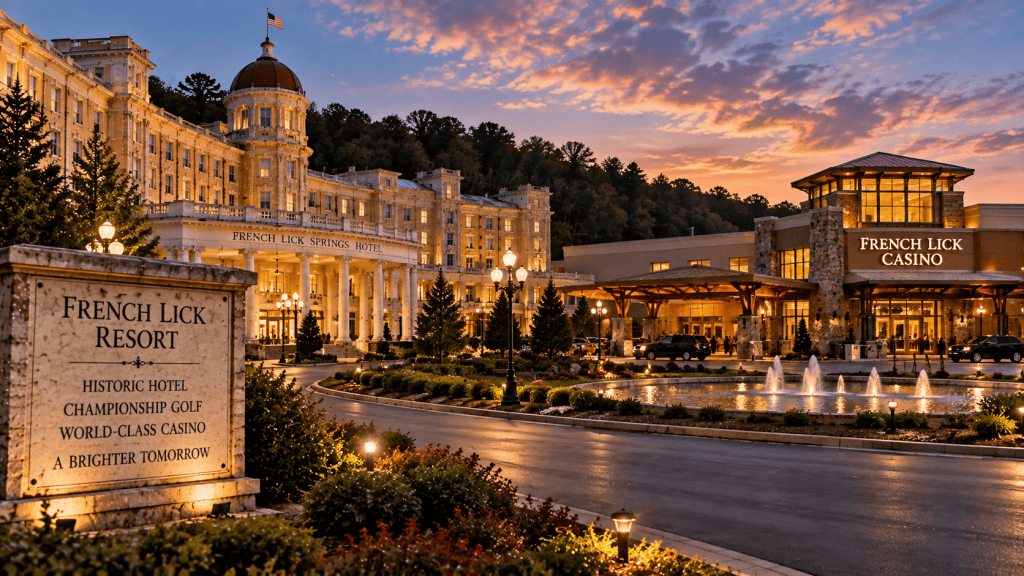
French Lick Springs Hotel would be restored.
West Baden Springs Hotel would be completed.
Historic golf would return.
And the properties would finally be connected as one resort destination.
Rebuilding French Lick
The scale of the project was extraordinary for a small southern Indiana community.
Cook Group and its partners undertook major restoration work at French Lick Springs Hotel.
Historic spaces were repaired.
Guest rooms were renovated.
Architectural details were restored.
The grounds were improved.
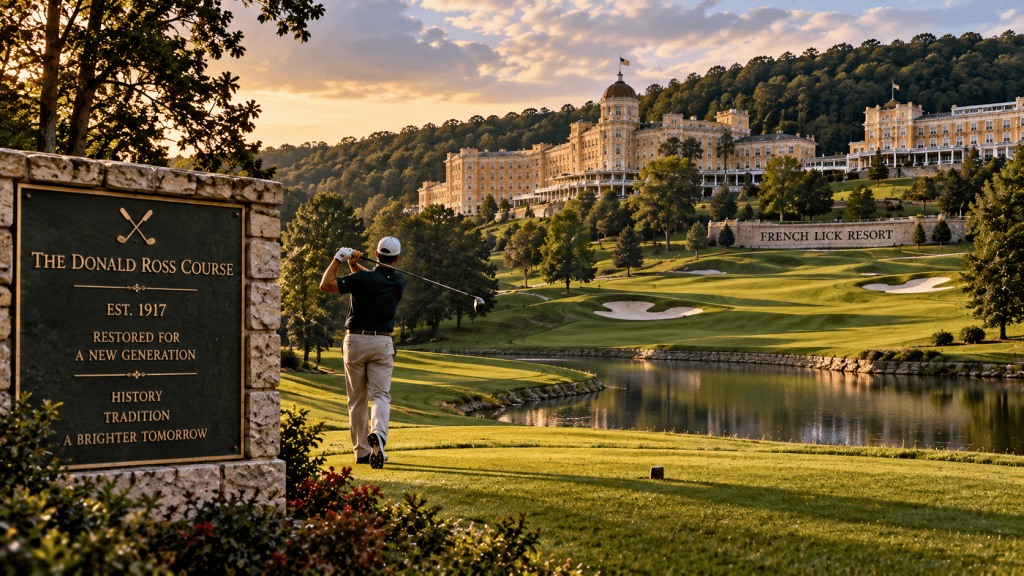
The historic Donald Ross golf course also underwent a multimillion-dollar restoration designed to return the course closer to Ross’s original vision.
In September 2006, the restored Donald Ross Course reopened.
Then came November.
November 2006: The Doors Open Again
On November 3, 2006, French Lick entered another era.
French Lick Springs Hotel reopened following its extensive renovation.
That same day, French Lick Casino opened.
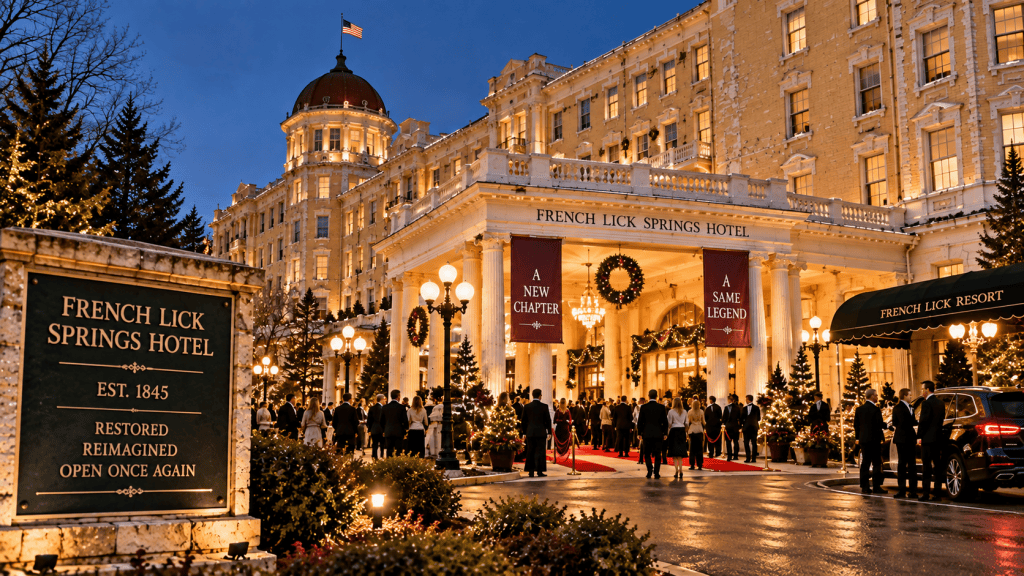
For the first time since the 1949 crackdown, casino gambling had returned to French Lick—this time as a legal, regulated part of the resort economy.
But there was still one enormous piece of the story left unfinished.
A mile away, the building that had nearly been lost was approaching a moment few people could have imagined when its wall collapsed in 1991.
West Baden was becoming a hotel again.
2007: The Eighth Wonder Returns
In May 2007, something happened at West Baden Springs Hotel that hadn’t happened in 75 years.
Guests checked in for the night.
For the first time since 1932, West Baden was operating as an overnight hotel.
The enormous atrium was once again filled with visitors.
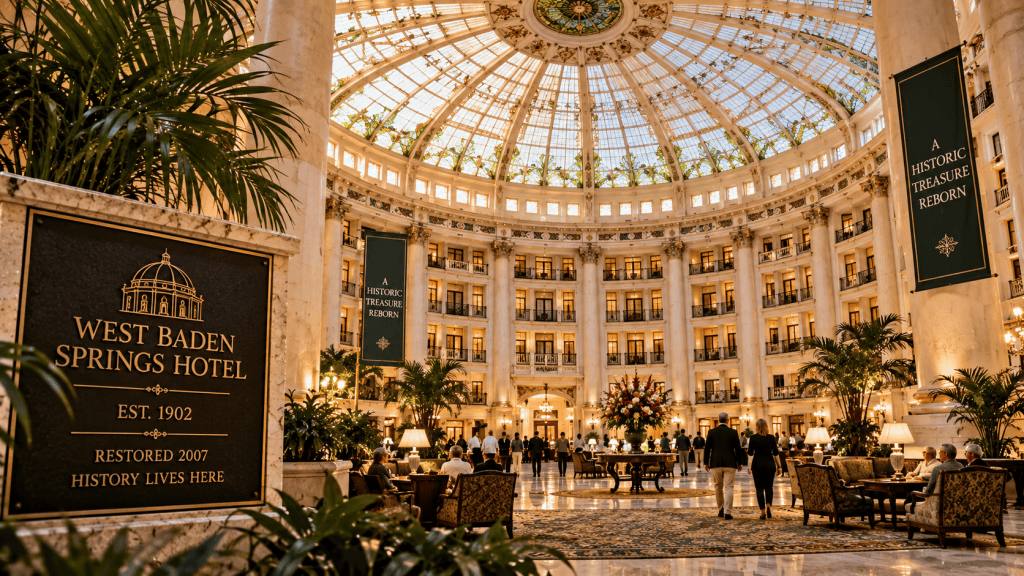
Guest rooms once again surrounded the dome.
People sat beneath a structure that only sixteen years earlier had stood beside a six-story pile of collapsed brick and debris.
West Baden hadn’t simply been prevented from falling down.
It had been returned to its original purpose.
That distinction makes its preservation story remarkable.
Many historic buildings survive by becoming something completely different.
West Baden had already done that—first as a seminary and then as a college.
But after decades of decline, abandonment and near catastrophe, it became a grand hotel again.
More Than Saving Two Buildings
The transformation extended beyond the hotels.
French Lick and West Baden again became a combined destination.
Historic golf returned.
New golf followed.
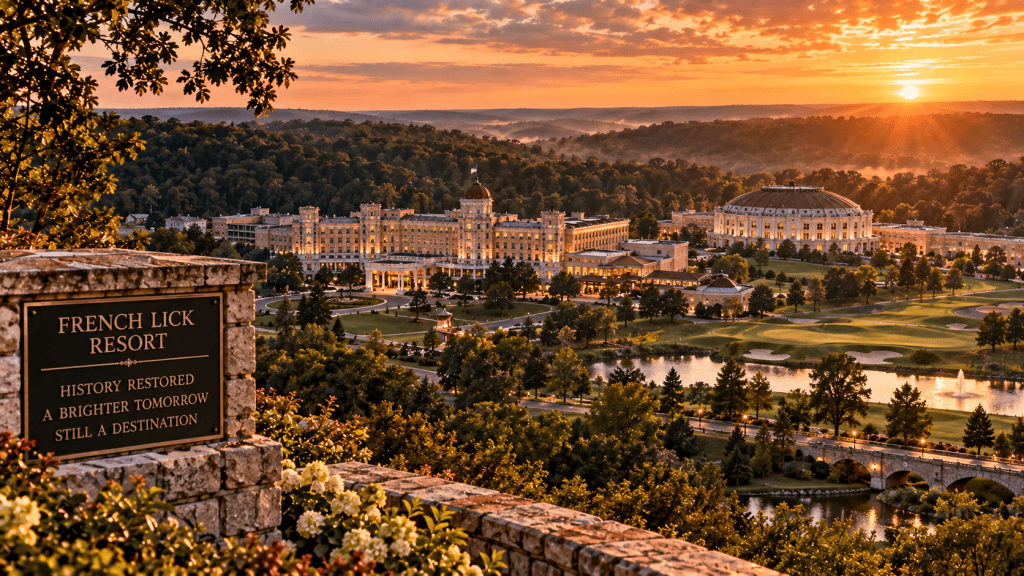
The Pete Dye Course opened in 2009 on the hills above the valley.
Visitors returned for the hotels, architecture, golf, casino, spas, restaurants, events and history.
Tourism once again became central to the local economy.
The mineral-water cures were no longer the attraction.
Pluto Water wasn’t being shipped across America.
Passenger trains weren’t unloading crowds of resort guests.
French Lick couldn’t recreate the world that had made it famous.
So it built something new around the pieces of that world that remained.
The Buildings Remember
Walk through French Lick today and pieces of nearly every chapter remain.
French Lick Springs Hotel still stretches across the landscape in its distinctive yellow brick.
The Donald Ross Course still follows the hills where golfers competed generations ago.
And inside West Baden, visitors can stand beneath the enormous dome and look upward.
It’s difficult to reconcile that view with photographs from 1991.
One shows polished floors, balconies and an enormous restored atrium.
The other shows a six-story section of the same building reduced to rubble.
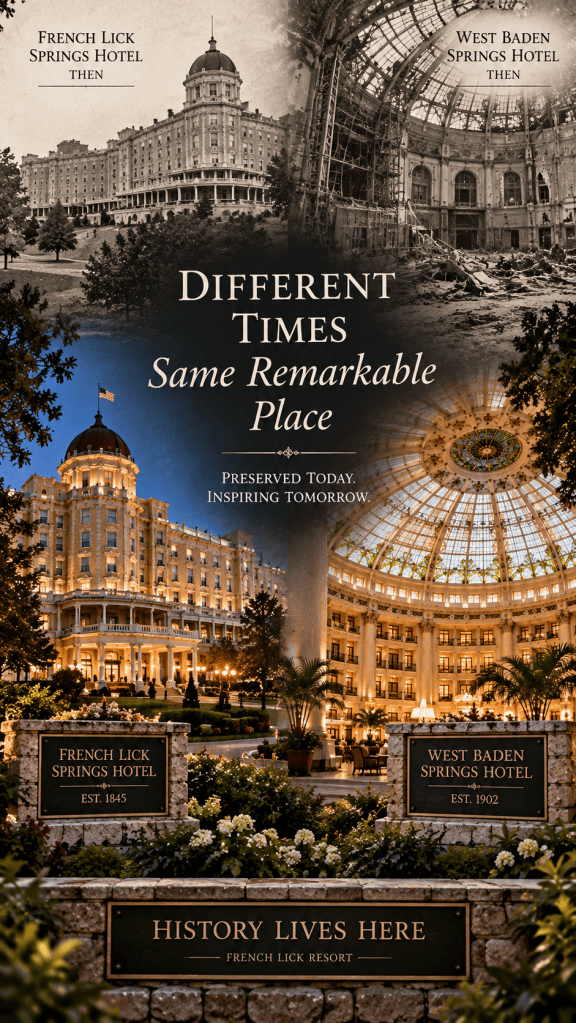
Only sixteen years separated the collapse from the hotel’s reopening.
That may be the most remarkable part of French Lick’s story.
Not that the town became famous.
But that after its original reason for being famous disappeared, it managed to become a destination again.
French Lick Found Another Road Forward
French Lick didn’t survive by becoming exactly what it had been before.
The mineral-water craze was gone.
The passenger trains were gone.
The world of Pluto Water, grand resort seasons and illegal gambling rooms belonged to another time.
But the buildings were still here.
So were the stories.
And instead of allowing that history to disappear, people found a way to make it part of the town’s future.
Today, visitors once again walk beneath the enormous dome at West Baden. They stay at French Lick Springs Hotel, play the historic golf courses and travel to a small southern Indiana town that, more than once, could have faded quietly into history.
French Lick didn’t find its way back by traveling the same road.
It found another road forward.
And sometimes that’s exactly how a town survives.
Keep Exploring
This is Part 2 of our French Lick story.
If you haven’t read how mineral springs, Pluto Water, Thomas Taggart, trains, gambling and championship golf first transformed this tiny southern Indiana community into a nationally known resort destination, start with Part 1:
French Lick, Indiana — The Town Built Around the Springs
And follow The Town You Passed as we continue exploring the small towns, forgotten places, local legends and unexpected stories hiding along the roads most of us drive right past.
You passed the town. We took the exit.

 The Town You Passed
Leave a comment